Backstroke in the Shallow End
This wasn't going to be a Coltrane post, but here we are

I’ve been digging Ethan Iverson’s missives here on substack. Those first five Bad Plus albums from ‘03 to ‘08 each had my music friends and I rapt when they came out during our early 20s. (It’s very precious, that kind of experience with someone’s work—following it as it comes out. There is simply no way to replicate this experience of being along for the ride of another group or artist’s trajectory in real-time, hearing them make sense of the same world you’re living through at that moment. Digesting an entire discography is one of my favorite ways to listen to music, but it’s just not the same.)
Here they are, hammering away at Physical Cities, 6 months before a recording of the tune was released. As kids we watched this tour, slack-jawed and dumbstruck, like some law of physics was being defied:
Anyway, I was enjoying a bit of Trane worship from Iverson just now, knowing that he’s more than a couple orders of magnitude more knowledgeable about the subject than me, and digging his account of these Miles/Trane bootlegs. Coltrane being One Of My Main Guys, I am always here for it, and I too will run my mouth about the holy man with anyone in my circles who’s also caught the bug.
The thing is: pound for pound, I don’t have a ton to say on the nuts and bolts of the work itself. I have not worked through any of his pieces, hell I don’t even play jazz. (Listen: I sometimes get a rep among non-jazz-guys for being a jazz guy; this is patently false, much as I wish it were not. I am not being modest—I simply do not have the shit together, end of story.)
One thing that I do carry from my student years, though, is a considerable appreciation for instrumental music in general (mostly from listening and reading history books on my own time, not so much from harmony class). But here’s the thing: I’m a rhythm guy, I kind of can’t do harmony for shit. I’m good for keeping whatever wacky temporal situation moving without much thought—odd time, polyrhythms, non-pulse-based rhythmic situations, weird subdivisions, metric modulation, imitating tape loops, all fine—but my harmonic material is honestly mostly intuitive and quite naive. It’s fine by me, but it does mean that listening to Coltrane is as standing colorblind in front of a Rothko1.
Like sort of, though. Most music has a few kinds of gifts to give. Some, pardon me, has more.
Coltrane and his work on Earth was something that looked upward. Much of it was, in all ways, towards God. Not as in Christian radio, which is categorically the worst shit you’ve ever heard in your life (although he did come to have a church founded after him). More like devotion to practice—to a practice.
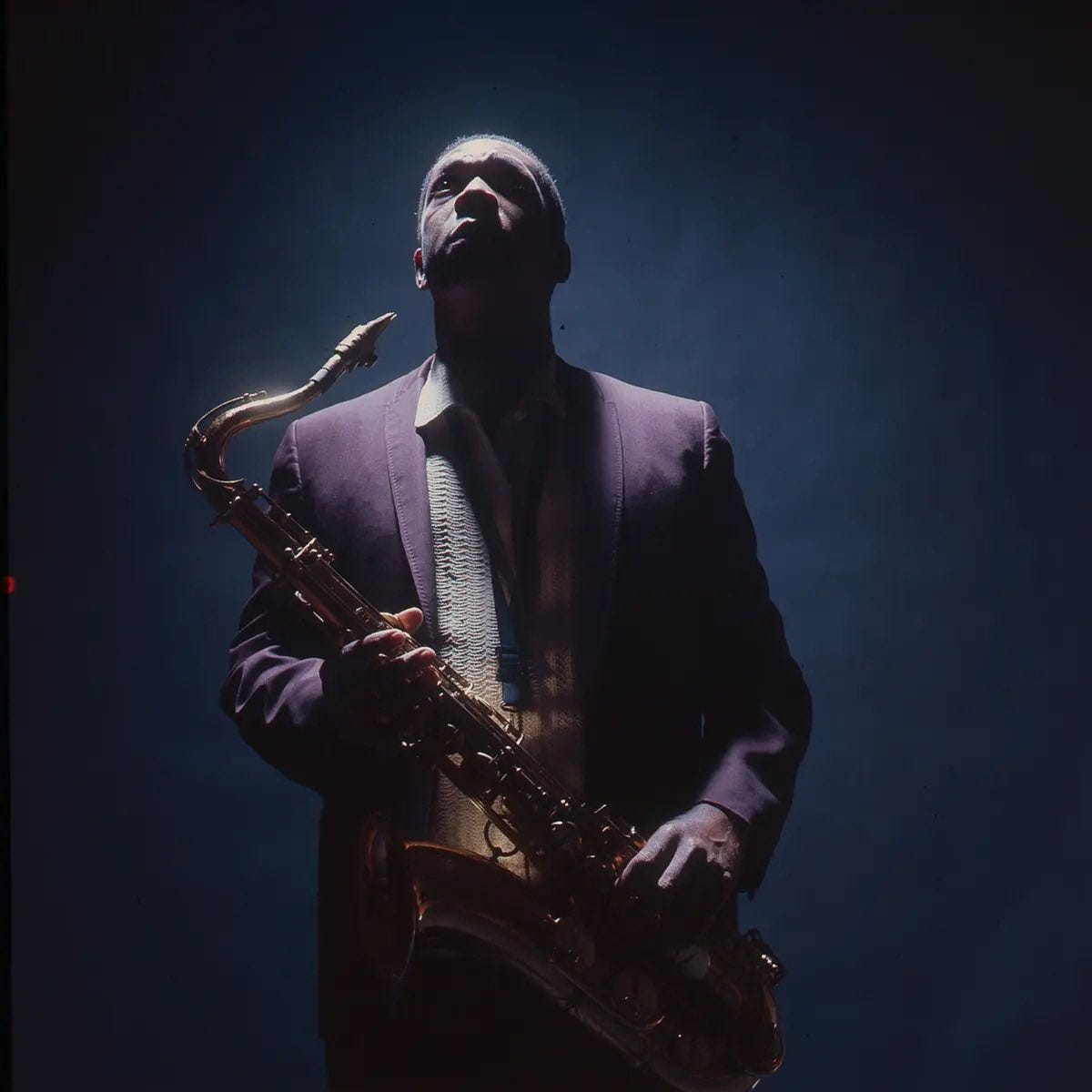
That upward and outward looking quality in his music is audible–you can literally hear it. It is contagious, ecstatic, unbelievable, deeply motivating.
Iverson is worth quoting at length here about these Miles/Coltrane bootlegs from their last tour together:
Some people think Miles sounds great on this tour. He is definitely in good form in general, but I personally think he is playing too long. My speculation is that Miles is forced into offering extra choruses because he knows what is about to happen.
The whole band knows, and the whole band is afraid:
After Miles stops playing, Coltrane is next.
By this point, Coltrane was wearing full regalia. He had it all together, from bebop to the songbook to the blues, and was ready to launch into more exploratory terrain. The band of Davis, Kelly, Chambers, and Cobb was merely state-of-the-art. Coltrane was past state-of-the-art and into the next phase.
On this European tour Trane frequently begins his solo by continuing with whatever idea Miles finished with. To me this scans as humble offering, a way of congratulating his boss: “Sounds good, Miles!”
After that brief name check, Trane enters into a new trance state of otherworldly virtuosity. Nobody played more saxophone anywhere, ever, than Trane on this 1960 Miles tour. Even his own music as a leader to follow isn’t quite like this, for he will have a band of innovative equals and the larger responsibility of delivering the John Coltrane message. On this 1960 Miles tour Trane is still a hired gun—and he isn’t trying to keep the gig, either.
It does not take much at all to hear what he’s describing:
Anyway, this actually wasn’t meant to be a Coltrane post as such. (See, though?). I was thinking about this joy of proximity to greatness that I feel around this stuff.
In time, I’d really like to deepen my understanding of the subject—of harmony in general, of Coltrane’s work, of Monk, Bartók, Debussy, Mingus, Bach, et. al. I’m not sure I’ll have time in this life to offer Giant Steps the years that it asks. But it would be nice.
I’d like to go deep on a lot of stuff, but you can spend a lifetime on analysis, produce no work of your own, and still not cover all the ground you want. You gotta choose how you spend your time.
Still, there is yet a pleasure in simply being in the presence of extreme depth, of taking it in and seeing how far into it you can see. There is great joy in getting close enough to these records to sing parts of them, and in understanding that to listen is to approach an ocean. So much the better when you can see others wading further out, telegraphing the view from inside their diving suits.
It is a pleasure to wade in and try to grasp the deep end, knowing that there’s no way to see all the way down just yet, but dunking your head in and squinting all the same. The stretch is the point.
And the stretch is immensely helpful in keeping oneself going through the punishing and embarrassing indignities of the musician’s life. It reminds you that wherever you’re at in your craft and career, however far you’ve waded out, these folks have swam out much further and found that it’s been good all the way out. It reminds you that music is not a waste of one’s time, it’s a practice older than money, older than law, older than the written word. And that’s some shit right there.
“There is never any end. There are always new sounds to imagine; new feelings to get at. And always, there is the need to keep purifying these feelings and sounds so that we can really see what we’ve discovered in its pure state. So that we can see more and more clearly what we are. In that way, we can give to those who listen the essence, the best of what we are. But to do that at each stage, we have to keep on cleaning the mirror.” -John Coltrane
Thanks for reading. If you like this and want to read more of it, you can become a free or paid subscriber.
Not that Rothko changed painting the way Coltrane changed jazz. But color was pretty much Rothko’s thing. And while Trane’s thing was transcendence, his path out of it was through harmony, not around.
I guess everyone has a Coltrane story. I encountered his music in a small kitchen over a small radio somewhere in Amsterdam last century. I have no idea for what reason, but one of the broadcasting organisations decided to play all his music. At that time shops closed at 6.00 pm. I still had to do some shopping. I had been listening for hours and I wanted to listen to it right to the end. No shopping done.